TurboQuant
Redefinindo a eficiência em IA
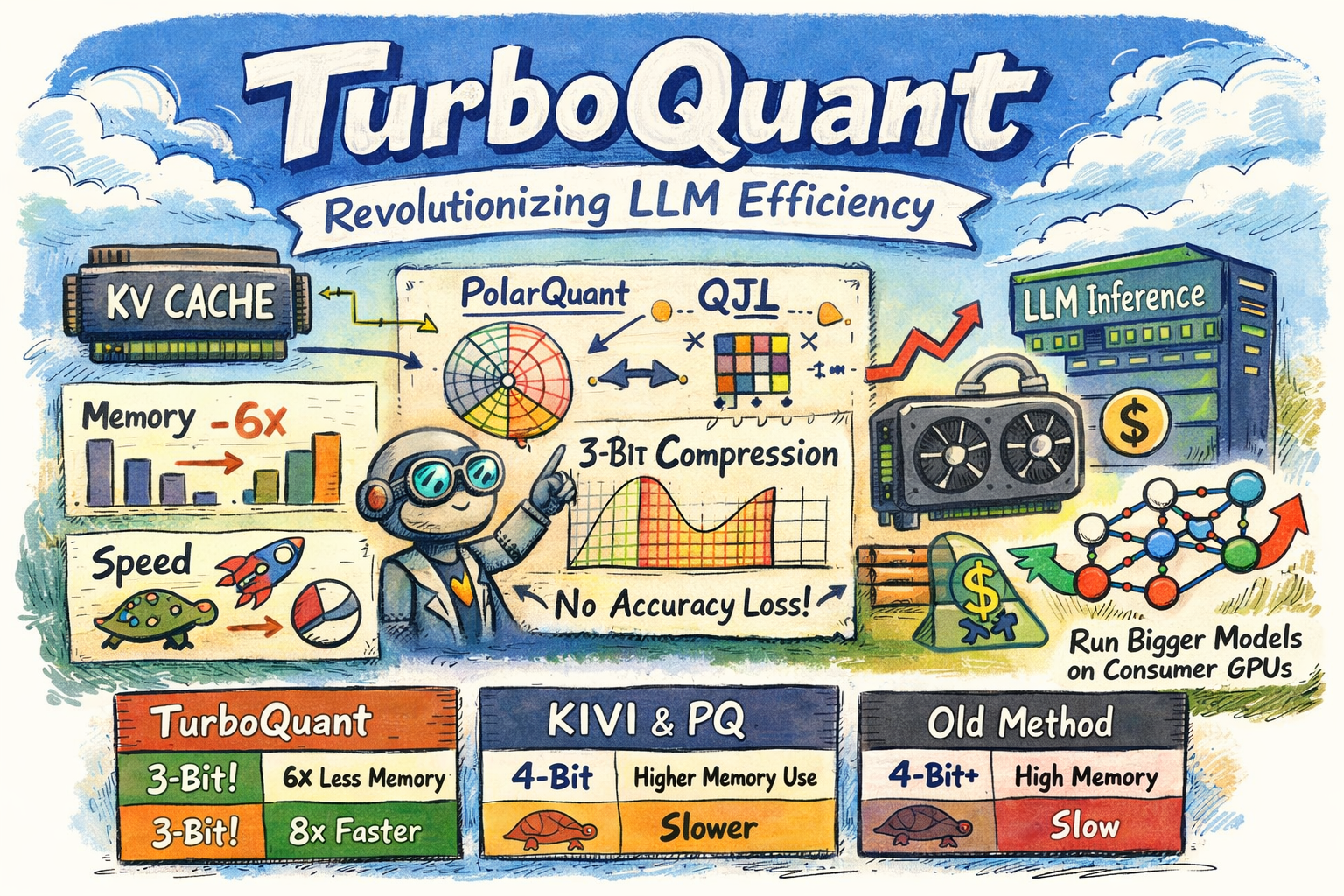
Um novo algoritmo online de quantização vetorial que entrega compressão de cache KV em 3 bits sem perda de precisão, reduz a memória em 6x e acelera a atenção em até 8x.
Últimos movimentos em torno do TurboQuant
Depois da publicação do artigo, a conversa rapidamente migrou para implementação, implantação e economia da inferência com contexto longo.
Últimas atualizações
Um desenvolvedor relatou ter concluído uma implementação de TurboQuant em MLX em 25 minutos usando GPT-5.4.
Ver postagemO lançamento enquadrou o TurboQuant como um método de quantização online próximo do ótimo teórico tanto para compressão de cache KV quanto para busca vetorial.
A conversa em código aberto avançou rápido para como levar o TurboQuant a stacks de inferência como llama.cpp e runtimes relacionados.
A questão central passou a ser se a compressão KV de 3 bits sem perda pode mudar o orçamento de memória e latência para serving com contexto longo.
Impacto
Após o lançamento do TurboQuant pela $GOOGL, $MU e $SNDK foram atingidas de forma acentuada na abertura do mercado.
A practical read on what TurboQuant changes
One expert view on what is likely already deployed, what still remains hard, and why the paper matters even if most easy gains are gone.
TurboQuant matters less because it saves a bit more memory, and more because it marks where KV-cache compression starts to hit a real boundary.
KV cache has long been the largest source of memory consumption in large-model inference. What this paper does, in essence, is compress that data in a way that approaches the information-theoretic optimum. It is not just lowering precision. It is reallocating information density: ordinary regions are represented with extremely low bits, while outliers retain higher precision. At the same time, the method stops treating values independently and instead encodes them at the vector level, which fits the inner-product structure of attention itself.
The critical point is that its error is already close to the information-theoretic lower bound, the Shannon limit. That means compression efficiency is already near the theoretical ceiling. The paper reports roughly 4x to 4.5x compression with little visible performance loss. The result is strong, but it also suggests there is not much room left for further compression without harming model quality.
Given how large-tech internal R&D usually works, the optimization effects implied by the paper were likely absorbed in stages before publication. Low-bit quantization has already been widely deployed, from int8 to int4 and beyond, across mainstream inference stacks. Separate handling for outliers is also not new: methods such as SmoothQuant and AWQ are already doing closely related things. KV-cache compression itself, sliding windows, and hierarchical cache designs are already standard practice in large-model systems.
What likely has not fully landed yet is the most extreme part of the paper: vector quantization and coding schemes that move closer to the information-theoretic limit. The barrier is not theory, but implementation. These methods are less GPU-friendly, harder to keep low-latency, and more difficult to stabilize and generalize in production, so they may take much longer to ship.
If I had to estimate roughly how much of the paper's benefit is already reflected in deployed systems, it would look something like this: the earliest KV cache starts at 1x cost; basic quantization gets to around 2x to 3x compression; adding outlier-aware handling can reach about 3x to 4x; the paper pushes that further to around 4x to 4.5x. In other words, most of the easy gains have already been captured. What remains is smaller in upside and increasingly expensive to realize.
The reason is straightforward. Early compression removes redundancy. Later compression starts to hit effective information, so every additional step has a much higher chance of hurting model capability. Error no longer degrades smoothly; beyond a certain point, it can worsen quickly. Engineering difficulty also does not grow linearly. It rises sharply.
You can infer from current model behavior that mainstream systems are already using many of these ideas. Better long-context behavior, lower inference cost, and stable performance all suggest that KV-cache efficiency has already been significantly improved. A team at Google's level has very likely already deployed low-bit quantization, outlier handling, and at least part of KV-cache compression.
That means if this Google paper has an impact on storage, much of that impact has probably already shown up. The parts that have not shown up yet will likely be harder to implement than the gains that came before.
More importantly, the significance of the paper is not just how much more memory it saves. It gives us a boundary. KV-cache compression is approaching its limit, and the remaining room is narrow. The next major change is unlikely to come from compression alone. It will require finding a different path.
Por que o TurboQuant parece mudar a categoria
TurboQuant não é apenas mais um truque de compressão. É um framework de quantização online próximo do limite teórico, ao mesmo tempo data-oblivious e amigável para aceleradores.
Métodos tradicionais (por exemplo, PQ)
- Require dataset-specific training
- Store many full-precision normalization constants
- Long indexing time
- Visible accuracy loss
TurboQuant
- Random rotation plus polar transform (PolarQuant)
- 1-bit residual correction (QJL) removes normalization overhead
- Near-zero indexing time
- Matches the 32-bit baseline on reported benchmarks
PolarQuant
Polar-transform core that eliminates normalization overhead
arXiv: 2502.02617 →Por que o TurboQuant importa
Um resumo rápido dos limites da quantização vetorial e da pressão do cache KV
1O problema clássico da quantização vetorial
Quantização vetorial comprime vetores de alta dimensão minimizando a distorção. Os limites teóricos são claros, mas os métodos tradicionais ainda ficam longe deles.
Fórmulas de distorção
Theory
Abordagens clássicas como PQ ainda ficam visivelmente acima desses limites.
2O gargalo do cache KV em LLMs
Em transformers decodificadores, cada token adiciona um par key/value. Com contextos longos, esse custo de memória passa a dominar o sistema.
Estimativa de memória
O que o TurboQuant muda
- ✓ Sem treinamento e sem finetuning
- ✓ 3,5 bits por canal para neutralidade de qualidade
- ✓ LongBench no nível do FP32
- ✓ Torna inferência de longo contexto mais viável em edge devices
3Aplicações em busca vetorial
Em sistemas ANN como FAISS, o TurboQuant melhora o recall mantendo o custo de indexação próximo de zero.
TurboQuant as a two-stage algorithm
TurboQuant = PolarQuant for main compression + QJL for residual correction
PolarQuant: polar-coordinate transform
The key idea is to remove per-block normalization overhead. PolarQuant rotates the vector randomly so coordinates follow a concentrated distribution that is easy to quantize.
Coordinate distribution
f_X(x) = Γ(d/2) / (√π · Γ((d-1)/2))
× (1 - x²)^((d-3)/2)

where x ∈ [-1, 1]
Why it works
- No per-block full-precision constantsOverhead drops to zero.
- Near-lossless beyond 4.2x compressionStronger than conventional baselines.
- Gaussian-like coordinates in high dimensionSupports optimal scalar quantizers such as Lloyd-Max.
Os números sustentam o argumento
Benchmarks em Gemma, Mistral e Llama-3.1-8B
Benchmarks de compressão do cache KV
| Benchmark | TurboQuant 3,5 bits | TurboQuant 2,5 bits | Cache completo |
|---|---|---|---|
| LongBench | 50.06 | 49.44 | 50.06 |
| Needle In A Haystack | 100 | 99.8 | 100 |
| ZeroSCROLLS | melhor | quase melhor | baseline |
| RULER | melhor | quase melhor | baseline |
| L-Eval | melhor | quase melhor | baseline |
Benchmark de busca vetorial (GloVe d=200)
1@k recall
Indexing time
Comparação com alternativas
| Método | Precisa de treino | Sem viés | Compressão | Aceleração |
|---|---|---|---|---|
| TurboQuant | Não | Sim | 6x+ | 8x |
| KIVI | Calibração | Não | 4x | 4x |
| SnapKV | Finetuning | Não | 2-4x | 2-4x |
| DuQuant | Calibração | Parcial | 4x | 4x |
Assumes RTX 4090 nominal VRAM of 24GB, with practical allocation rounded up after framework overhead.
| Model | Weights | Pure model VRAM | Total VRAM before | Total VRAM after | 4090s before | 4090s after | Change |
|---|---|---|---|---|---|---|---|
| ChatGLM-4 (9B) | BF16 | 18 GB | 19.8 GB | 18.3 GB | 1 | 1 | Extra headroom on a single 4090. |
| ChatGLM-4 (9B) | INT8 | 9 GB | 10.8 GB | 9.3 GB | 1 | 1 | Still single-card, with more buffer. |
| ChatGLM-4 (9B) | INT4 | 5 GB | 6.8 GB | 5.3 GB | 1 | 1 | Very comfortable single-card fit. |
| Qwen-2.5 (32B) | BF16 | 64 GB | 69 GB | 64.8 GB | 3 | 3 | Savings help, but not enough to drop a GPU. |
| Qwen-2.5 (32B) | INT8 | 32 GB | 37 GB | 32.8 GB | 2 | 2 | More margin on a 2x4090 node. |
| Qwen-2.5 (32B) | INT4 | 18 GB | 23 GB | 18.8 GB | 2 | 1(-1) | Pulled back under the single-4090 limit. |
| Llama-3.1 (70B) | BF16 | 140 GB | 150 GB | 141.7 GB | 7 | 6(-1) | Drops one RTX 4090 at 100K context. |
| Llama-3.1 (70B) | INT8 | 70 GB | 80 GB | 71.7 GB | 4 | 3(-1) | Material hardware cost reduction. |
| Llama-3.1 (70B) | INT4 | 38 GB | 48 GB | 39.7 GB | 3 | 2(-1) | Brings 70B into a practical dual-4090 envelope. |
| Mixtral 8x22B (141B MoE) | BF16 | 282 GB | 288 GB | 283 GB | 13 | 13 | MoE keeps KV share relatively small. |
| Mixtral 8x22B (141B MoE) | INT8 | 141 GB | 147 GB | 142 GB | 7 | 7 | Lower pressure, but same card class. |
| Mixtral 8x22B (141B MoE) | INT4 | 75 GB | 81 GB | 76 GB | 4 | 4 | Useful slack without a node count change. |
| DeepSeek-R1 (671B MoE) | FP8 | 700 GB | 712 GB | 702 GB | 31 | 30(-1) | Saves one 4090 even at hyperscale. |
| DeepSeek-R1 (671B MoE) | INT4 | 350 GB | 362 GB | 352 GB | 16 | 15(-1) | Still too large for small nodes, but one card disappears. |
Do paper à produção
Como integrar TurboQuant em uma stack real
Estado atual
O artigo traz a teoria e o pseudocódigo, mas ainda não há implementação open source oficial. O trabalho de integração na comunidade já começou.
- •llama.cpp Discussion #20969 is tracking integration ideas
- •Experiments in MLX report around 5x compression with 99.5% quality retention
- •Open-source code is widely expected around Q2 2026
Esboço de implementação
Precompute Lloyd-Max centroids
Do it once offline and reuse them.
# Python-like pseudocode
centroids = lloyd_max_quantizer(
    distribution="beta",
    bits=b
)Generate a random rotation matrix
Use QR decomposition to build an orthogonal matrix.
# random rotation
G = np.random.randn(d, d)
Pi, _ = np.linalg.qr(G)
Build quant / dequant primitives
This is the core path for storage and recovery.
def quant(x, Pi, centroids):
    y = Pi @ x
    idx = find_nearest(y, centroids)
    return idx

def dequant(idx, Pi, centroids):
    y = centroids[idx]
    x = Pi.T @ y
return xIntegrate inside attention
Store K/V in TurboQuant form and estimate inner products with QJL.
# Transformer attention
k_quant = turboquant_quant(k)
v_quant = turboquant_quant(v)
# use QJL during attention
Notas de implantação
Hardware
H100 and A100 are ideal. 4-bit mode is where the paper reports 8x speedups.
Mixed precision
Use TurboQuant for KV cache and INT4 for weights to maximize total compression.
Edge devices
3-bit KV cache can make 32K+ context feasible on phones with software-only implementations.
Riscos práticos e mitigação
Random rotation overhead
Pre-generate and reuse the matrices instead of rebuilding them online.
Residual norm storage
One FP16 scalar is small enough to keep the overhead negligible.
Como o TurboQuant pode deslocar a stack de IA
LLM inference
Million-token contexts become materially cheaper, with a path to native support in future model stacks.
Vector databases
Real-time indexing and sub-millisecond search become easier to deliver.
Edge AI
Long-context inference on mobile and embedded devices becomes more realistic.
Multimodal embeddings
The same ideas can extend to image and video embedding compression.
Theory extensions
Combining with outlier-handling methods could push the field toward practical 2-bit systems.
Community impact
Expect rapid follow-through from ecosystems such as vLLM and Hugging Face.
Linha do tempo esperada
2026 Q2
Open-source code and framework integrations
2026 Q4
Commercial products, likely cloud-first
2027
Potential normalization as an LLM quantization standard
Nota de risco: tratamento ruim da semente aleatória pode introduzir pequeno viés, mas o artigo argumenta que o efeito é desprezível em alta dimensão.
Perguntas frequentes
As primeiras perguntas que engenheiros e leitores costumam fazer