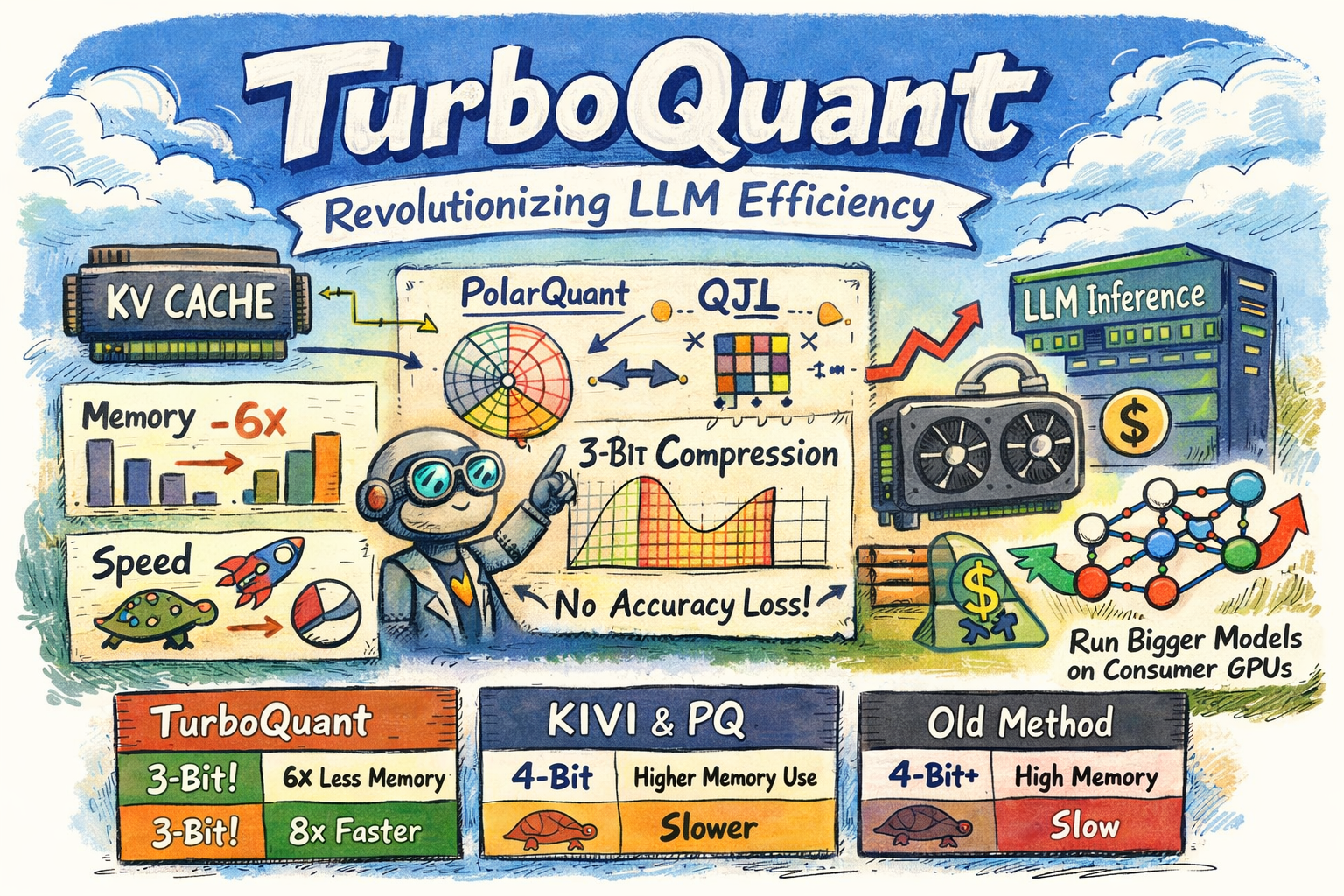
TurboQuant를 둘러싼 최신 흐름
논문 공개 직후 논의는 빠르게 구현, 배포, 장문맥 추론 비용 구조로 확장됐습니다.
최신 업데이트
한 개발자가 GPT-5.4를 사용해 25분 만에 TurboQuant의 MLX 구현을 끝냈다고 공유했습니다.
원문 보기공개 발표에서는 TurboQuant를 KV 캐시 압축과 벡터 검색을 모두 포괄하는 정보이론 근접형 온라인 양자화 기법으로 제시했습니다.
오픈소스 논의는 곧바로 llama.cpp 같은 추론 스택과 관련 런타임에 TurboQuant를 어떻게 넣을지로 이어졌습니다.
논의의 핵심은 3비트 무손실 KV 압축이 장문맥 서빙의 메모리와 지연 시간 예산을 바꿀 수 있는지로 옮겨갔습니다.
영향
$GOOGL의 TurboQuant 발표 이후 $MU와 $SNDK는 개장 시점에 크게 흔들렸습니다.
A practical read on what TurboQuant changes
One expert view on what is likely already deployed, what still remains hard, and why the paper matters even if most easy gains are gone.
TurboQuant matters less because it saves a bit more memory, and more because it marks where KV-cache compression starts to hit a real boundary.
KV cache has long been the largest source of memory consumption in large-model inference. What this paper does, in essence, is compress that data in a way that approaches the information-theoretic optimum. It is not just lowering precision. It is reallocating information density: ordinary regions are represented with extremely low bits, while outliers retain higher precision. At the same time, the method stops treating values independently and instead encodes them at the vector level, which fits the inner-product structure of attention itself.
The critical point is that its error is already close to the information-theoretic lower bound, the Shannon limit. That means compression efficiency is already near the theoretical ceiling. The paper reports roughly 4x to 4.5x compression with little visible performance loss. The result is strong, but it also suggests there is not much room left for further compression without harming model quality.
Given how large-tech internal R&D usually works, the optimization effects implied by the paper were likely absorbed in stages before publication. Low-bit quantization has already been widely deployed, from int8 to int4 and beyond, across mainstream inference stacks. Separate handling for outliers is also not new: methods such as SmoothQuant and AWQ are already doing closely related things. KV-cache compression itself, sliding windows, and hierarchical cache designs are already standard practice in large-model systems.
What likely has not fully landed yet is the most extreme part of the paper: vector quantization and coding schemes that move closer to the information-theoretic limit. The barrier is not theory, but implementation. These methods are less GPU-friendly, harder to keep low-latency, and more difficult to stabilize and generalize in production, so they may take much longer to ship.
If I had to estimate roughly how much of the paper's benefit is already reflected in deployed systems, it would look something like this: the earliest KV cache starts at 1x cost; basic quantization gets to around 2x to 3x compression; adding outlier-aware handling can reach about 3x to 4x; the paper pushes that further to around 4x to 4.5x. In other words, most of the easy gains have already been captured. What remains is smaller in upside and increasingly expensive to realize.
The reason is straightforward. Early compression removes redundancy. Later compression starts to hit effective information, so every additional step has a much higher chance of hurting model capability. Error no longer degrades smoothly; beyond a certain point, it can worsen quickly. Engineering difficulty also does not grow linearly. It rises sharply.
You can infer from current model behavior that mainstream systems are already using many of these ideas. Better long-context behavior, lower inference cost, and stable performance all suggest that KV-cache efficiency has already been significantly improved. A team at Google's level has very likely already deployed low-bit quantization, outlier handling, and at least part of KV-cache compression.
That means if this Google paper has an impact on storage, much of that impact has probably already shown up. The parts that have not shown up yet will likely be harder to implement than the gains that came before.
More importantly, the significance of the paper is not just how much more memory it saves. It gives us a boundary. KV-cache compression is approaching its limit, and the remaining room is narrow. The next major change is unlikely to come from compression alone. It will require finding a different path.
TurboQuant가 판을 바꾸는 결과로 보이는 이유
TurboQuant는 단순한 압축 기법이 아니라, 정보이론적 한계에 가까우면서도 데이터 비의존적이고 가속기 친화적인 온라인 양자화 프레임워크입니다.
기존 방법 (예: PQ)
- 데이터셋별 학습 필요
- 정규화 상수를 많이 저장해야 함
- 인덱싱 시간이 길다
- 정확도 손실이 눈에 띈다
TurboQuant
- 무작위 회전 + 극좌표 변환 (PolarQuant)
- 1비트 잔차 보정 (QJL)으로 정규화 오버헤드 제거
- 거의 0에 가까운 인덱싱 시간
- 보고된 벤치마크에서 32비트 기준선과 동일
왜 TurboQuant가 필요한가
벡터 양자화 한계와 KV 캐시 병목을 빠르게 정리합니다.
1벡터 양자화의 고전적 문제
벡터 양자화는 고차원 벡터를 작은 코드로 바꾸면서 왜곡을 최소화하는 문제입니다. 이론적 하한은 분명하지만, 기존 방식은 실제로 거기까지 가지 못합니다.
왜곡 공식
Theory
PQ 같은 전통적 방법은 이 하한보다 여전히 상당히 높습니다.
2LLM의 KV 캐시 병목
디코더 기반 트랜스포머에서는 토큰마다 Key/Value를 저장해야 하므로, 컨텍스트가 길어질수록 메모리 비용이 빠르게 지배적이 됩니다.
메모리 추정
TurboQuant가 바꾸는 점
- ✓ 학습과 미세조정이 필요 없음
- ✓ 채널당 3.5비트로 품질 중립성 달성
- ✓ LongBench가 FP32와 동일
- ✓ 엣지 기기에서도 장문맥 추론 가능성 확대
3벡터 검색 적용
FAISS 같은 ANN 시스템에서 TurboQuant는 인덱싱 오버헤드를 거의 0으로 유지하면서 더 높은 리콜을 제공합니다.
TurboQuant의 2단계 알고리즘
TurboQuant = 주 압축을 담당하는 PolarQuant + 잔차 보정을 담당하는 QJL
PolarQuant: 극좌표 변환
핵심은 블록별 정규화 오버헤드를 제거하는 것입니다. PolarQuant는 무작위 회전으로 좌표를 더 양자화하기 쉬운 집중 분포로 바꿉니다.
좌표 분포
f_X(x) = Γ(d/2) / (√π · Γ((d-1)/2))
× (1 - x²)^((d-3)/2)

where x ∈ [-1, 1]
핵심 장점
- 블록별 전정밀 상수 제거오버헤드가 0이 됩니다.
- 4.2배 이상 압축에서도 거의 무손실기존 기준선보다 강합니다.
- 고차원에서 가우시안 유사 좌표Lloyd-Max 같은 최적 스칼라 양자화기를 바로 적용할 수 있습니다.
숫자가 주장이다
Gemma, Mistral, Llama-3.1-8B 전반의 벤치마크
KV 캐시 압축 벤치마크
| 벤치마크 | TurboQuant 3.5비트 | TurboQuant 2.5비트 | 전체 캐시 |
|---|---|---|---|
| LongBench | 50.06 | 49.44 | 50.06 |
| Needle In A Haystack | 100 | 99.8 | 100 |
| ZeroSCROLLS | 최상 | 거의 최상 | 기준선 |
| RULER | 최상 | 거의 최상 | 기준선 |
| L-Eval | 최상 | 거의 최상 | 기준선 |
벡터 검색 벤치마크 (GloVe d=200)
1@k 리콜
인덱싱 시간
대안 대비 비교
| 방법 | 학습 필요 | 비편향 | 압축률 | 속도 향상 |
|---|---|---|---|---|
| TurboQuant | 아니오 | 예 | 6x+ | 8x |
| KIVI | 보정 | 아니오 | 4x | 4x |
| SnapKV | 미세조정 | 아니오 | 2-4x | 2-4x |
| DuQuant | 보정 | 부분적 | 4x | 4x |
Assumes RTX 4090 nominal VRAM of 24GB, with practical allocation rounded up after framework overhead.
| Model | Weights | Pure model VRAM | Total VRAM before | Total VRAM after | 4090s before | 4090s after | Change |
|---|---|---|---|---|---|---|---|
| ChatGLM-4 (9B) | BF16 | 18 GB | 19.8 GB | 18.3 GB | 1 | 1 | Extra headroom on a single 4090. |
| ChatGLM-4 (9B) | INT8 | 9 GB | 10.8 GB | 9.3 GB | 1 | 1 | Still single-card, with more buffer. |
| ChatGLM-4 (9B) | INT4 | 5 GB | 6.8 GB | 5.3 GB | 1 | 1 | Very comfortable single-card fit. |
| Qwen-2.5 (32B) | BF16 | 64 GB | 69 GB | 64.8 GB | 3 | 3 | Savings help, but not enough to drop a GPU. |
| Qwen-2.5 (32B) | INT8 | 32 GB | 37 GB | 32.8 GB | 2 | 2 | More margin on a 2x4090 node. |
| Qwen-2.5 (32B) | INT4 | 18 GB | 23 GB | 18.8 GB | 2 | 1(-1) | Pulled back under the single-4090 limit. |
| Llama-3.1 (70B) | BF16 | 140 GB | 150 GB | 141.7 GB | 7 | 6(-1) | Drops one RTX 4090 at 100K context. |
| Llama-3.1 (70B) | INT8 | 70 GB | 80 GB | 71.7 GB | 4 | 3(-1) | Material hardware cost reduction. |
| Llama-3.1 (70B) | INT4 | 38 GB | 48 GB | 39.7 GB | 3 | 2(-1) | Brings 70B into a practical dual-4090 envelope. |
| Mixtral 8x22B (141B MoE) | BF16 | 282 GB | 288 GB | 283 GB | 13 | 13 | MoE keeps KV share relatively small. |
| Mixtral 8x22B (141B MoE) | INT8 | 141 GB | 147 GB | 142 GB | 7 | 7 | Lower pressure, but same card class. |
| Mixtral 8x22B (141B MoE) | INT4 | 75 GB | 81 GB | 76 GB | 4 | 4 | Useful slack without a node count change. |
| DeepSeek-R1 (671B MoE) | FP8 | 700 GB | 712 GB | 702 GB | 31 | 30(-1) | Saves one 4090 even at hyperscale. |
| DeepSeek-R1 (671B MoE) | INT4 | 350 GB | 362 GB | 352 GB | 16 | 15(-1) | Still too large for small nodes, but one card disappears. |
논문에서 제품까지
실제 스택에 TurboQuant를 넣는 방법
현재 상태
논문은 이론과 의사코드를 제공하지만 공식 오픈소스 구현은 아직 없습니다. 다만 커뮤니티 통합 작업은 이미 시작됐습니다.
- •llama.cpp Discussion #20969에서 통합 아이디어를 추적 중
- •MLX 실험은 약 5배 압축과 99.5% 품질 보존을 보고
- •2026년 2분기 전후로 오픈소스 공개가 널리 예상됨
구현 스케치
Precompute Lloyd-Max centroids
Do it once offline and reuse them.
# Python-like pseudocode
centroids = lloyd_max_quantizer(
    distribution="beta",
    bits=b
)Generate a random rotation matrix
Use QR decomposition to build an orthogonal matrix.
# random rotation
G = np.random.randn(d, d)
Pi, _ = np.linalg.qr(G)
Build quant / dequant primitives
This is the core path for storage and recovery.
def quant(x, Pi, centroids):
    y = Pi @ x
    idx = find_nearest(y, centroids)
    return idx

def dequant(idx, Pi, centroids):
    y = centroids[idx]
    x = Pi.T @ y
return xIntegrate inside attention
Store K/V in TurboQuant form and estimate inner products with QJL.
# Transformer attention
k_quant = turboquant_quant(k)
v_quant = turboquant_quant(v)
# use QJL during attention
배포 메모
하드웨어
H100과 A100이 이상적입니다. 논문의 8배 가속은 4비트 모드 기준입니다.
혼합 정밀도
KV 캐시는 TurboQuant, 가중치는 INT4를 사용해 전체 압축을 극대화합니다.
엣지 기기
3비트 KV 캐시는 휴대폰에서도 32K+ 문맥을 현실화할 수 있습니다.
실무 리스크와 완화책
무작위 회전 오버헤드
행렬을 미리 생성해 재사용하면 온라인 비용을 줄일 수 있습니다.
잔차 norm 저장
FP16 스칼라 하나면 충분해서 오버헤드는 매우 작습니다.
TurboQuant가 AI 스택을 바꿀 수 있는 방식
LLM 추론
백만 토큰 문맥 비용이 크게 낮아지고, 차세대 모델 스택의 기본 기능이 될 수 있습니다.
벡터 데이터베이스
실시간 인덱싱과 서브밀리초 검색이 더 쉬워집니다.
엣지 AI
모바일과 임베디드 환경의 장문맥 추론이 현실에 가까워집니다.
멀티모달 임베딩
같은 아이디어를 이미지와 비디오 임베딩 압축으로 확장할 수 있습니다.
이론 확장
아웃라이어 처리와 결합하면 실용적 2비트 시스템으로 더 다가갈 수 있습니다.
커뮤니티 영향
vLLM과 Hugging Face 같은 생태계가 빠르게 따라올 가능성이 높습니다.
예상 일정
2026 Q2
오픈소스 코드와 프레임워크 통합
2026 Q4
상용 제품, 아마도 클라우드 우선
2027
LLM 양자화 표준으로 자리잡을 가능성
리스크 노트: 랜덤 시드를 잘못 다루면 작은 편향이 생길 수 있지만, 논문은 고차원에서 영향이 미미하다고 봅니다.
자주 묻는 질문
엔지니어가 먼저 묻는 핵심 질문